
Oil Tank Replacement Cost in Lowell, MA: What Homeowners Should Know
How much does oil tank replacement cost in Lowell, MA? If your heating oil tank is showing signs of rust, developing leaks, or approaching the end of its service life, understanding the potential expenses can help you plan before a bigger problem develops.
The cost of replacing an oil tank depends on its size, construction, location, accessibility, and the work required to remove the existing equipment. Homeowners considering oil tank replacement in Lowell, MA should also account for fuel handling, new connections, and applicable permit and inspection requirements.
At Quality Oil Tank Replacement, we help Lowell homeowners explore replacement options involving Granby and Roth heating oil tanks. Whether you have a 275-gallon basement tank, an older outdoor above-ground tank, or are considering a double-wall replacement, understanding the cost factors can make your decision easier.
Want to know what oil tank replacement will cost at your property? Call 978-622-2344 or request a personalized quote.
Request an Oil Tank Replacement Quote
How Much Does Oil Tank Replacement Cost in Lowell, MA?
There is no single price that applies to every residential heating oil tank replacement in Lowell.
A straightforward above-ground replacement with suitable access may involve less work than removing a tank from a narrow basement, relocating piping, or upgrading equipment to meet current installation requirements.
The total project cost generally reflects several components:
- New oil tank: The manufacturer, model, capacity, and construction influence equipment pricing.
- Installation labor: Includes the work required to position, connect, and prepare the new tank.
- Old tank removal: May involve fuel handling, disconnection, cleaning, removal, and approved disposal.
- Piping and fittings: Existing fill, vent, and fuel lines may need assessment or replacement.
- Site preparation: Some installations require additional supports, suitable clearances, or relocation.
- Permits and inspections: Applicable local requirements may affect the scope and cost.
- Unexpected conditions: Damaged components, difficult access, or suspected contamination may require additional work.
An online estimate cannot account for all these conditions.
For reliable pricing,
request a written quote based on your existing tank and the installation conditions at your Lowell property.
Get a free quote
Oil Tank Replacement Cost page
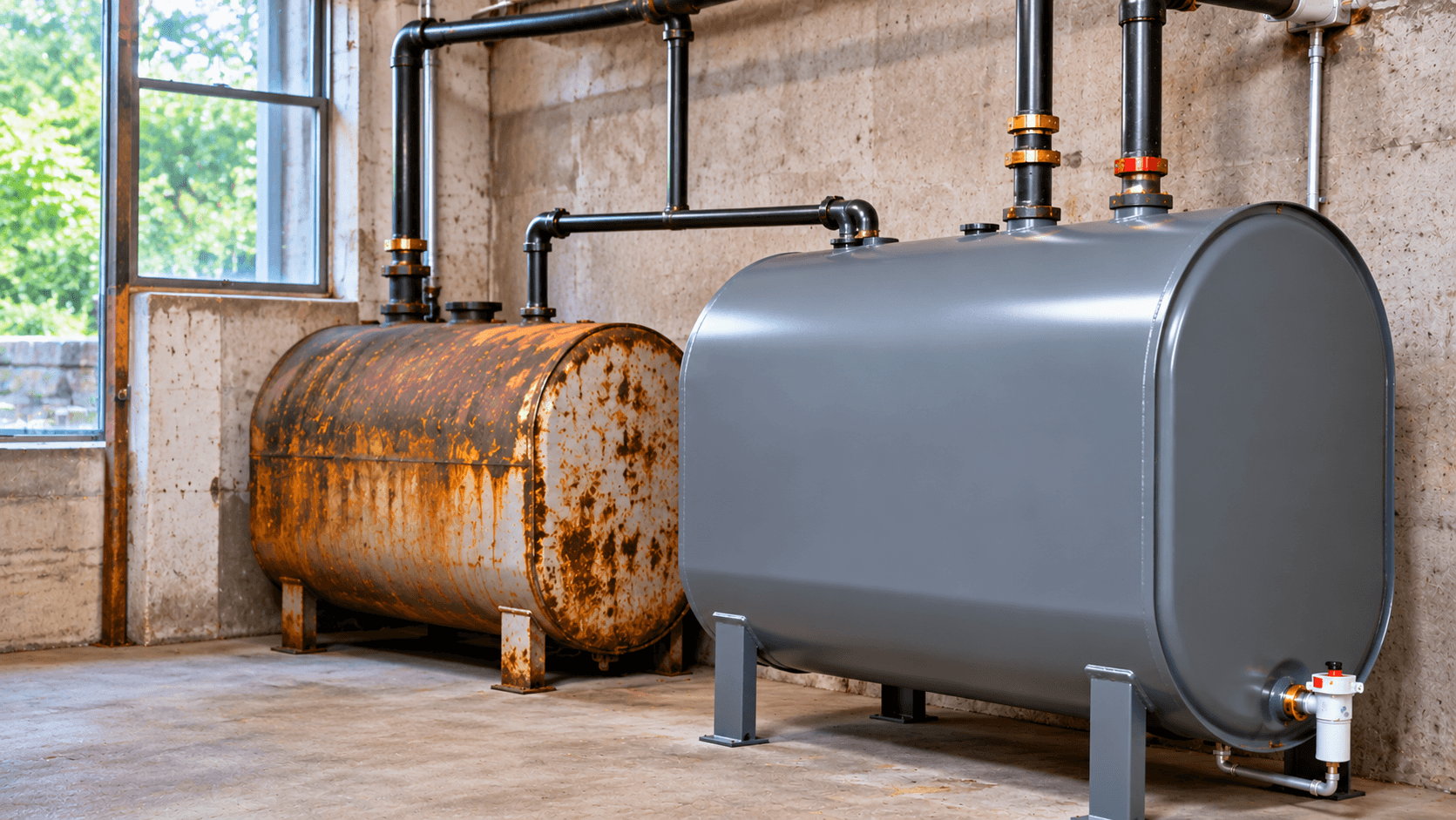
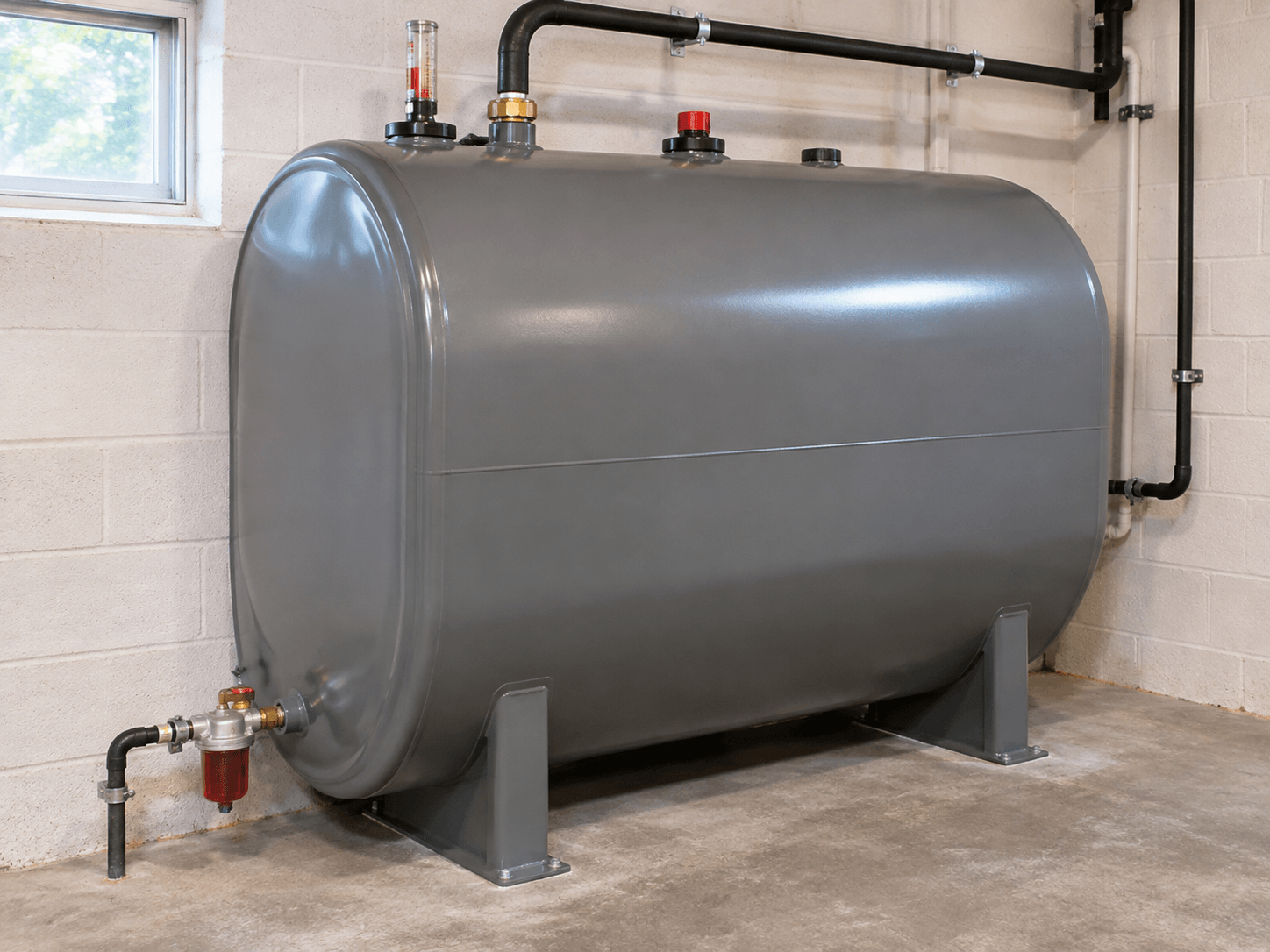
What Affects Oil Tank Replacement Costs?
1. Oil Tank Size: 275 Gallon vs. 330 Gallon
Residential heating oil tanks are available in several capacities, including common nominal sizes such as 275 and 330 gallons.
The appropriate tank size depends on your home's fuel storage needs, available installation space, and the compatible equipment options.
A larger tank may cost more to purchase, but total installation cost does not necessarily increase in direct proportion to capacity.
For example, replacing a 275-gallon tank with another tank of compatible dimensions may involve different work from upgrading to a larger unit that requires additional space or modified connections.
Before selecting a size, consider:
- Available basement or outdoor space.
- Safe access for installation and future maintenance.
- Existing fill and vent arrangements.
- Household oil consumption.
- Heating oil delivery arrangements.
- Manufacturer requirements and applicable codes.
The nominal tank capacity should not be confused with the usable amount of fuel that can safely be delivered.
2. Single-Wall vs. Double-Wall Tank Construction
The construction of your replacement tank can influence the upfront price and the type of protection it provides.
Single-wall steel tanks use a primary containment vessel to store heating oil.
Double-wall systems incorporate additional containment or protective features, depending on the manufacturer and model.
A double-wall tank often has a higher initial equipment cost, but some homeowners prefer the additional containment design.
However, no tank design eliminates every possibility of a fuel leak. Connections, piping, fill operations, and proper installation remain important.
3. Basement vs. Outdoor Installation
Tank location can affect both labor and materials.
Indoor basement tanks may require careful planning when stairs, doorways, or narrow access points make removal and installation difficult.
Outdoor above-ground tanks require attention to weather exposure, stable support, accessibility, and manufacturer-approved placement.
A tank that is easy to reach may be less complicated to replace than one located behind finished walls or in a confined utility space.
4. Condition of the Existing Tank
The existing tank's condition can affect how it must be handled.
A tank with intact fittings and no indication of leakage may present different removal requirements from one with severe corrosion, residual sludge, damaged connections, or suspected fuel release.
If the old tank has leaked, environmental assessment and cleanup may be separate from an ordinary replacement project.
5. Fuel Transfer and Disposal
An existing heating oil tank may still contain usable fuel.
A replacement project may require assessment of the fuel condition, suitable temporary handling, and decisions about whether fuel can be transferred or must be managed as waste.
Contaminated fuel or sludge may require special handling and disposal.
Do not assume that all remaining fuel can be reused or that disposal is automatically included in every installation quote.
6. Permits and Installation Requirements
Tank replacement may require permits, inspections, and work that meets applicable state and local requirements.
For Lowell properties, the applicable approvals depend on the tank configuration and scope of work.
The City of Lowell's Fire Prevention Bureau and Development Services permitting information are useful starting points for confirming local requirements.
Ask your contractor which permits and inspections apply, who is responsible for obtaining them, and whether their costs are included in the estimate.
Oil Tank Replacement Cost by Tank Type
Different tank designs have different equipment and installation requirements.
Here is how to compare the options without relying on generic prices.
| Tank option | Main consideration | What can affect the final cost |
|---|---|---|
| Standard steel tank | Conventional single-wall storage | Size, location, supports, piping, and removal |
| Enhanced-protection steel tank | Additional protective features depending on model | Specific model, construction, and installation |
| Double-wall tank | Additional containment design | Equipment price, dimensions, connections, and accessories |
| Larger-capacity tank | More nominal fuel storage | Available space, handling, supports, and piping |
The best choice depends on the existing installation, homeowner priorities, manufacturer requirements, and total project cost.
Roth vs. Granby Oil Tanks: Which Costs More?
Quality Oil Tank Replacement features both Roth and Granby heating oil storage solutions.
These brands offer different tank constructions and product models, so comparing them requires more than choosing by price alone.
Roth Oil Tanks
Roth is known for double-wall heating oil tank systems that combine an inner storage vessel with an outer containment shell.
Depending on the model, these systems include features designed to help monitor the condition of the primary tank.
Roth tanks may be worth considering when a homeowner prefers a compatible double-wall design.
When comparing quotes, ask for the exact model number, capacity, dimensions, warranty documentation, and installation requirements.
Learn more about Roth oil tank options in Lowell, MA.
Granby Oil Tanks
Granby offers a range of residential heating oil storage tanks, including conventional steel and models with additional protective features.
Different products have different construction methods, coatings, dimensions, and warranty conditions.
A Granby tank may be appropriate when its size and design suit the existing installation and the homeowner's requirements.
Compare the specific model rather than assuming every Granby tank has the same construction or protection features.
Explore Granby oil tank options in Lowell, MA.
Which Option Is Better for Your Budget?
A conventional steel tank may have a different upfront equipment price from a double-wall model.
However, the lowest tank price does not necessarily represent the lowest total installed cost.
Installation access, fittings, fuel handling, supports, and required modifications all affect the estimate.
Ask for itemized proposals using comparable capacities and installation scopes.
Also review the actual manufacturer's warranty conditions. Do not assume a particular warranty period, environmental coverage amount, or insurance discount applies to every tank or installation.
How Much Does It Cost to Replace a 275-Gallon Oil Tank in Lowell?
A 275-gallon heating oil tank is a common residential size, but replacement costs vary.
A homeowner replacing an accessible basement tank with a similar model may have different requirements from someone upgrading to a double-wall system or relocating the tank.
Important questions include:
- Is the existing tank indoors or outdoors?
- Can it be removed without substantial modifications?
- Is there heating oil remaining in the tank?
- Are the existing pipes and fittings suitable for reuse?
- Does the new equipment need different supports or clearances?
- Are permits and inspections required?
- Has any leakage or contamination been identified?
Instead of relying on an outdated advertised price, request a quote that identifies the equipment, labor, removal, and any additional work.
Need a 275-gallon oil tank replacement estimate? Call 978-622-2344 to discuss your Lowell installation.
Is Replacing a 330-Gallon Oil Tank More Expensive?
A 330-gallon tank generally requires more storage capacity than a 275-gallon model, but the final replacement cost depends on the product and installation.
A larger tank may involve different dimensions, weight, positioning, and handling requirements.
If you are increasing capacity, the existing tank location may not have enough clearance for the new equipment.
Before upgrading, confirm that the proposed tank fits the available space and meets applicable installation requirements.
A contractor can help compare suitable tank capacities and their total installation costs.
Is Oil Tank Removal Included in the Replacement Price?
Oil tank removal and replacement are related services, but they should be clearly identified in the quote.
Some contractors provide a combined price for removing an existing tank and installing a new one.
Other proposals may itemize removal, fuel handling, disposal, and installation separately.
What May Be Involved in Removing an Old Tank?
Depending on the condition and location, the work can involve:
- Assessing the existing tank and connections.
- Arranging safe fuel handling.
- Disconnecting applicable piping.
- Preparing the tank for removal.
- Moving the tank from the property.
- Arranging appropriate disposal or recycling.
If the tank has leaked, environmental response or remediation may require separate qualified specialists.
For homeowners who need removal without a replacement, see our oil tank removal services in Lowell, MA.
Ask About These Potential Additional Charges
Before approving work, clarify whether the proposal includes:
- Removal of the old tank.
- Remaining fuel handling.
- Tank cleaning and preparation.
- Disposal or recycling.
- New fill and vent piping.
- Fuel supply line modifications.
- Applicable permits and inspections.
- Final testing.
- Cleanup of the normal work area.
A complete scope of work makes quotes easier to compare and reduces the chance of misunderstandings.
What Happens During an Oil Tank Replacement?
The exact process depends on the equipment and site conditions.
Step 1: Assess the Existing Tank
The installation area, equipment condition, tank capacity, piping, and available access should be evaluated.
Visible rust, questionable supports, and indications of leakage deserve particular attention.
Step 2: Select the New Tank
A suitable tank is selected according to required capacity, available space, manufacturer specifications, and installation requirements.
The homeowner should understand the differences between proposed equipment options.
Step 3: Plan Fuel Handling and Old Tank Removal
Any remaining heating oil must be managed appropriately.
The existing tank should be prepared and disconnected by qualified personnel following applicable procedures.
Step 4: Prepare the Installation Area
The new tank location may need suitable support, required clearances, and modifications to the fill, vent, or fuel supply connections.
All work should be planned around the selected equipment and applicable standards.
Step 5: Install and Connect the Replacement Tank
The new equipment is positioned and connected using suitable components and approved installation methods.
Tank fittings, venting arrangements, and fuel lines must match the requirements of the selected tank system.
Step 6: Inspect and Verify the Completed Work
Before the installation is placed into normal service, appropriate checks and any required inspections should be completed.
Homeowners should receive relevant documentation, warranty information, and instructions for monitoring the tank.
Why Oil Tank Condition Matters in Massachusetts
Heating oil storage tanks can deteriorate with age, exposure, moisture, and other conditions.
Steel tanks can experience corrosion, including deterioration that may not be obvious from a casual visual inspection.
A leaking tank may damage building materials or contaminate soil and groundwater.
According to the Massachusetts Department of Environmental Protection's homeowner cleanup guidance, heating oil releases can create environmental problems requiring professional assessment and, in some cases, regulated cleanup.
Replacing a questionable tank before it leaks may help homeowners manage the project more predictably.
However, tank age alone is not proof that a specific tank is unsafe. An appropriate inspection should consider its condition, construction, installation, and maintenance history.
Warning Signs That Deserve Attention
Consider arranging a professional inspection if you notice:
- Visible rust, pitting, or significant corrosion.
- Damp or oily areas around the tank.
- A persistent unexplained heating oil odor.
- Staining near fittings or fuel lines.
- Damaged, loose, or unstable tank supports.
- Evidence of seepage or leakage.
- An aging tank with limited maintenance records.
Do not attempt to weld, patch, drill, or pressure-test an old tank yourself.
What If You Suspect an Oil Leak?
If you discover an active heating oil release, do not treat it as a routine replacement quote request.
Avoid handling the oil or attempting untrained cleanup, especially near drains, soil, or waterways.
MassDEP directs people to contact the local fire department immediately and report environmental emergencies through its 24-hour response line at 1-888-304-1133.
See the official Massachusetts oil spill and environmental emergency reporting instructions.
A leaking tank may require environmental response separate from the installation of a replacement tank.
Oil Tank Replacement Considerations for Lowell Homes
Lowell has a variety of residential properties, including older houses, multi-family buildings, and renovated homes.
An existing oil tank may be installed in a basement, utility area, or an outdoor location.
The property's design can influence installation planning and cost.
Older Homes and Basement Access
Some older properties have narrow stairways, limited utility-room access, or existing piping arrangements that complicate tank removal.
Before selecting a new tank, confirm that it can be safely moved through the available access route and installed with appropriate clearances.
Multi-Family Properties
Buildings with multiple residential units may have different fuel storage arrangements and access requirements.
The project scope should account for the equipment configuration and any additional approvals relevant to the building.
Tank Placement and Local Requirements
Tank installation requirements may differ depending on the equipment, location, and work being performed.
For properties in Lowell neighborhoods such as Belvidere, Centralville, Pawtucketville, Highlands, and South Lowell, the actual building conditions are more important than applying a one-size-fits-all installation recommendation.
Confirm local service availability and the applicable requirements before scheduling work.
How to Compare Oil Tank Replacement Quotes
A replacement quote should allow you to understand what you are purchasing.
Two estimates can appear similar while covering very different services.
Compare the Exact Tank Model
Ask for the manufacturer, model, capacity, and construction of the proposed tank.
This is especially important when comparing standard steel tanks with double-wall systems.
Compare Installation Scope
Check whether both estimates cover the same piping, supports, fuel handling, equipment removal, and testing.
Ask About Permits and Inspections
Confirm which approvals are required and who will arrange them.
Review Warranty Terms
Separate the manufacturer's equipment warranty from any workmanship warranty provided by the installer.
Request the applicable written terms and confirm any registration or installation conditions.
Clarify What Happens if Additional Work Is Found
Unexpected corrosion, damaged connections, or access limitations can affect project costs.
Ask how additional work will be communicated and approved before it proceeds.
Why Contact Quality Oil Tank Replacement?
Choosing a heating oil tank replacement provider involves more than finding the lowest advertised price.
Homeowners need to understand the proposed equipment, installation requirements, old tank handling, and total project scope.
Quality Oil Tank Replacement offers information and enquiries for homeowners considering Granby and Roth oil tank solutions in Lowell, Massachusetts.
When requesting a quote, provide details about your existing tank, the installation location, and any visible problems.
Before agreeing to work, confirm the contractor's relevant qualifications, insurance, equipment availability, permit responsibilities, warranty terms, and quoted services.
A clear proposal should help you compare options without relying on unsupported savings guarantees or generic online prices.
Ready to compare replacement options? Contact Quality Oil Tank Replacement for a quote based on your property.
Frequently Asked Questions About Oil Tank Replacement Cost in Lowell, MA
How much does oil tank replacement cost in Lowell, MA?
The price depends on tank size, model, installation location, existing equipment condition, removal, piping, and applicable permits. A property-specific estimate is more reliable than an older online price range.
How much does it cost to replace a 275-gallon oil tank?
The installed cost depends on the tank selected, access to the existing tank, fuel handling, removal, and any connection or support modifications. Ask for a quote that identifies all included work.
Is a Roth oil tank more expensive than a standard steel tank?
A Roth double-wall tank may have a higher upfront equipment cost than a conventional single-wall steel tank. The overall installed price also depends on the specific model and project requirements.
Is Granby a good option for oil tank replacement?
Granby manufactures several residential heating oil tank models with different construction and protective features. The appropriate option depends on your installation requirements, budget, and preferred tank design.
Does the replacement price include old oil tank removal?
Not necessarily. Ask whether removal, fuel handling, disposal, and installation are included in the written quote. Never assume they are covered.
How long does oil tank replacement take?
Completion time depends on tank accessibility, fuel handling, piping work, equipment availability, and any required approvals. The contractor should provide a schedule based on the actual project.
Do I need a permit to replace an oil tank in Lowell, MA?
Applicable permits and inspections depend on the tank and scope of work. Confirm the requirements with the Lowell Fire Prevention Bureau, other appropriate city authorities, and the contractor before installation.
Should I replace my oil tank before it starts leaking?
If a tank shows significant corrosion or other signs of deterioration, arrange an assessment promptly. Proactive replacement of a deteriorating tank may reduce the risk of a future release.
Can I reuse the heating oil from my old tank?
Some fuel may be reusable if its condition and the transfer arrangements are suitable. Contaminated oil or sludge may require different handling. Have qualified personnel assess the options.
Does a new oil tank reduce heating oil consumption?
Replacing a storage tank does not automatically improve burner efficiency or lower fuel use. Heating consumption depends primarily on the heating equipment, building condition, weather, and operating habits.
Will replacing my oil tank reduce homeowners insurance costs?
Insurance requirements and pricing depend on the insurer and policy. A new tank may affect underwriting decisions, but no specific discount or coverage approval should be assumed. Confirm the details with your insurance provider.
Can an oil tank be replaced in winter?
Some replacements may be possible during winter, depending on weather, equipment availability, safe working conditions, and the heating arrangements needed during the project.
What if my oil tank is already leaking?
An active leak requires prompt attention and may trigger environmental reporting and cleanup obligations. Contact the local fire department and follow MassDEP's spill-reporting instructions rather than waiting for a routine installation appointment.
Request an Oil Tank Replacement Quote in Lowell, MA
If you're concerned about an aging oil tank, comparing tank brands, or planning a replacement, the next step is to understand the work required at your property.
Quality Oil Tank Replacement can be contacted to discuss heating oil tank replacement options in Lowell, Massachusetts.
For a more useful initial estimate, provide:
- Your name and contact information.
- Your Lowell address or ZIP code.
- The tank's approximate capacity, if known.
- Whether the tank is indoors or outdoors.
- The current tank brand or model, if known.
- Any visible rust, damage, or other concerns.
- Whether you are interested in a Roth or Granby replacement.
You can also ask about removal, installation, fuel handling, and which services are included in a written proposal.
Get clear information about your replacement options before committing to a new oil tank.
Request Your Oil Tank Replacement Quote
Call Quality Oil Tank Replacement: 978-622-2344
Serving Lowell, Massachusetts — confirm availability for your property.