
Oil Tank Replacement in Lowell, MA – Residential Heating Oil Tank Services
Is your heating oil tank showing signs of rust, developing suspicious stains, or approaching the point where replacement may be necessary? An aging oil tank can become a concern for homeowners, especially when its condition is uncertain and the heating season is approaching.
At Quality Oil Tank Replacement, we help homeowners explore oil tank replacement in Lowell, MA, including options for replacing older above-ground heating oil tanks with compatible Roth or Granby models. If you are planning a replacement and want to understand the potential expenses, our oil tank replacement cost guide for Lowell, MA explains the factors that affect project pricing.
Replacing a heating oil tank involves more than purchasing a new container. The existing equipment, remaining fuel, installation location, piping, access, and applicable safety requirements all need consideration.
Concerned about your existing oil tank? Call Quality Oil Tank Replacement at 978-622-2344 or request a replacement quote.
Request an Oil Tank Replacement Quote
Residential Oil Tank Replacement Services in Lowell, MA
Many homes in Massachusetts continue to rely on heating oil for space heating or domestic hot-water equipment.
The storage tank is an important part of that system because it holds the fuel supplied to the heating appliance.
Over time, some heating oil tanks can deteriorate due to corrosion, moisture, installation conditions, or physical damage.
A tank that has developed significant corrosion or questionable structural integrity should be evaluated before continued use.
For Lowell homeowners, a replacement project may involve:
- Assessing the condition of an existing oil tank.
- Selecting a suitable replacement tank.
- Planning safe handling of remaining heating oil.
- Preparing the existing equipment for removal.
- Arranging appropriate removal and disposal.
- Positioning and installing the new tank.
- Evaluating fill, vent, and fuel supply connections.
- Completing applicable checks and inspections.
The exact scope depends on the equipment and property.
A properly planned replacement should address the condition of the existing tank and the requirements of the new system rather than automatically reusing every existing component.
Get a free quote
Oil tank replacement pg
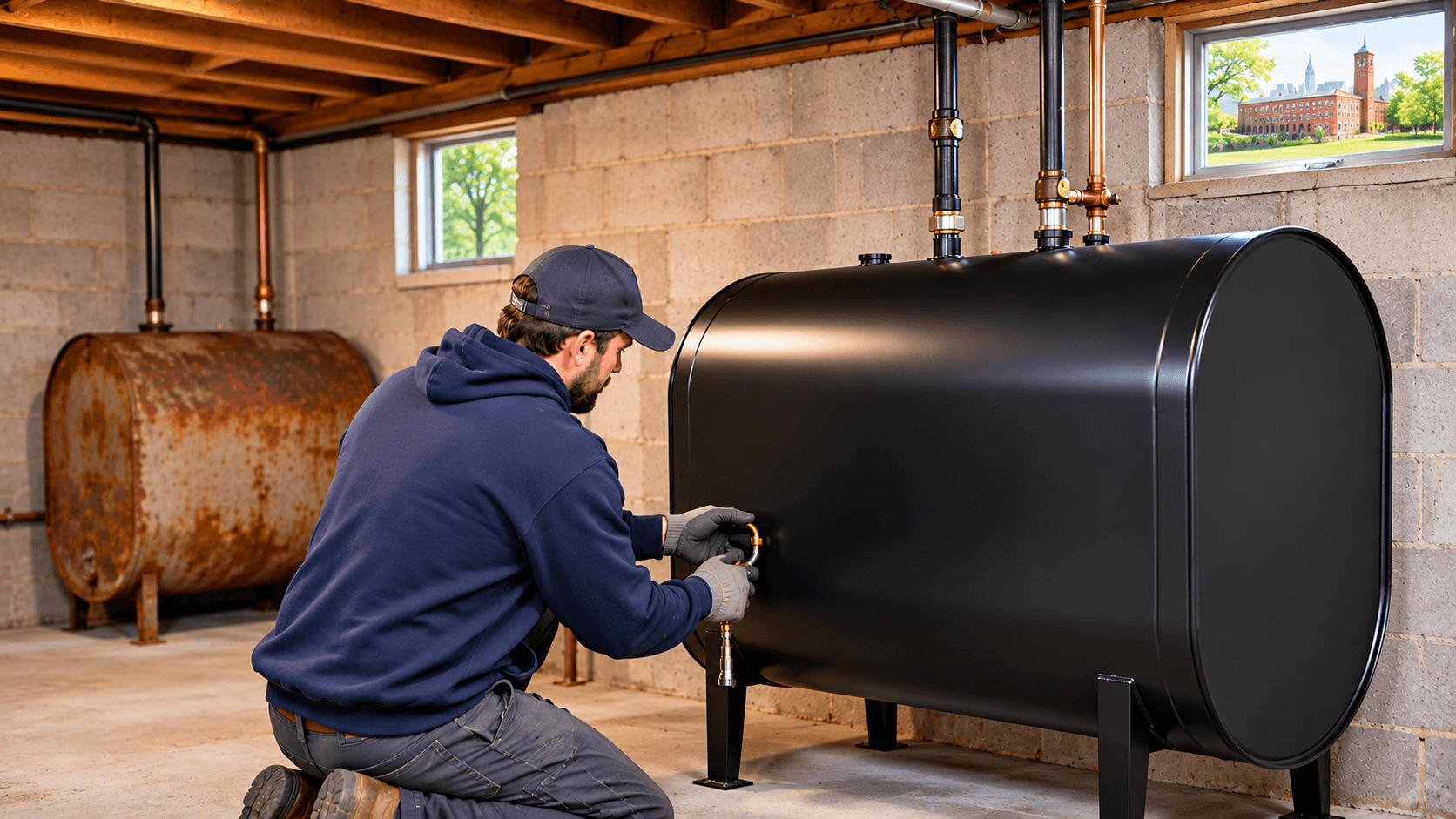
When Should You Replace Your Heating Oil Tank?
An older tank does not automatically need replacement solely because of its age. However, visible deterioration, uncertain maintenance history, or suspected leakage should prompt an appropriate inspection.
Visible Rust or Corrosion
Steel heating oil tanks can corrode when exposed to moisture or other unfavorable conditions.
Rust on the exterior may indicate a need for closer examination, although visible rust alone does not establish the full condition of the tank.
Internal corrosion may also occur, particularly when water accumulates inside the storage vessel.
Painting over visible rust does not correct internal deterioration or restore weakened metal.
Oil Stains or Damp Spots Near the Tank
Unexplained oily staining, dampness, or residue beneath a tank can be an indication of leakage.
However, oil may also originate from a fitting, filter, or connected fuel line.
The source should be identified by appropriately qualified personnel.
If an active release is suspected, follow the emergency guidance below rather than treating the situation as an ordinary replacement appointment.
Damaged or Unstable Tank Supports
Oil tanks must be supported according to the manufacturer's instructions and applicable installation requirements.
Corroded legs, unstable supports, damaged bases, or noticeable tilting can create safety concerns.
Avoid attempting to lift, move, or straighten a filled oil tank yourself.
Persistent Heating Oil Odors
An unexplained heating oil smell around the tank or associated piping should be investigated.
Odors do not always mean the tank itself is leaking, but they can indicate a problem with fuel storage or delivery components.
Do not ignore recurring odors or attempt to conceal them with cleaning products.
Frequent Fuel Supply Problems
Recurring blocked filters, sludge-related issues, or interruptions in fuel supply can have several causes.
The problem may involve contaminated fuel, water accumulation, aging supply lines, or other heating-system components.
A tank inspection can help determine whether replacement is appropriate or whether a separate fuel system repair is needed.
An Older Tank With Limited Maintenance Records
If you recently purchased an older Lowell property and do not know the tank's installation date, condition, or maintenance history, arranging an assessment is sensible.
The tank's age should be considered alongside its construction, location, visible condition, and any available documentation.
What Types of Oil Tanks Can Be Considered for Replacement?
Heating oil tanks are manufactured in different capacities, materials, and configurations.
The appropriate choice depends on your existing system, storage needs, installation space, and applicable requirements.
Conventional Steel Oil Tanks
Steel tanks are commonly found in residential heating oil installations.
They are available in different sizes and configurations, including models designed for indoor or other approved above-ground installations.
When considering a steel tank, review the exact model's construction, protective features, manufacturer specifications, and installation requirements.
Double-Wall Heating Oil Tanks
Double-wall tanks incorporate an additional containment layer or shell surrounding the primary storage vessel.
This design can provide an additional level of protection if the primary vessel develops a problem.
However, double-wall construction does not eliminate every potential source of leakage.
Fuel lines, fill connections, fittings, and installation practices remain important.
Roth Oil Tank Replacement
Roth offers double-wall residential heating oil storage systems.
Certain models use a polyethylene inner tank surrounded by a protective steel outer shell.
These tanks may be an option for homeowners considering double-wall containment.
The appropriate model depends on its dimensions, approved use, capacity, compatibility, and installation conditions.
Explore our Roth oil tank options in Lowell, MA.
Granby Oil Tank Replacement
Granby manufactures residential heating oil tanks, including conventional steel models and other designs with additional protective features.
Different Granby products have different specifications and warranty conditions.
Homeowners should compare the actual model being proposed rather than assume every tank from the manufacturer is constructed in the same way.
Learn more about
Granby oil tanks in Lowell, MA.
How to Choose the Right Replacement Oil Tank
Choosing a replacement tank involves more than matching the old tank's gallon capacity.
Tank Capacity and Fuel Storage Needs
Common residential tank capacities include nominal 275-gallon and 330-gallon options.
The best capacity depends on the household's fuel use, delivery arrangements, available space, and compatible equipment.
A larger tank is not necessarily required simply because the existing tank is older.
The tank's nominal capacity should also not be confused with the amount of fuel that can be safely delivered during filling.
Indoor Basement Installation
Basement oil tank replacement can involve limited access, narrow stairways, existing pipes, or confined utility areas.
A replacement model should be selected with its physical dimensions and required service clearances in mind.
The route used to remove the old tank and bring in the new equipment also needs consideration.
Outdoor Above-Ground Installation
Outdoor tanks are exposed to weather, moisture, temperature changes, and possible physical damage.
Support, stability, access, and protection from falling snow or ice should be evaluated in accordance with applicable requirements.
The proposed tank must be suitable for its intended location.
Compatibility With Existing Fuel Connections
Existing fill pipes, vent pipes, gauges, and fuel supply lines should be evaluated as part of the project.
Components should not be reused solely because they appear to fit.
Compatibility, condition, manufacturer instructions, and applicable standards all matter.
Our Oil Tank Replacement Process: What Homeowners Should Expect
A residential heating oil tank replacement should follow a carefully planned process.
The exact procedures depend on tank construction, condition, access, remaining fuel, and the scope of work.
Step 1: Evaluate the Existing Oil Tank
The first stage is assessing the tank and its installation conditions.
Relevant details include the tank's approximate age, capacity, location, visible condition, fuel quantity, and connections.
The assessment should also consider whether there are signs of leakage or other problems that require attention before routine replacement proceeds.
Step 2: Select an Appropriate Replacement Tank
After reviewing the installation conditions, suitable tank options can be compared.
The proposed equipment should match the property's space, storage requirements, and relevant manufacturer specifications.
For homeowners considering Roth or Granby products, the exact model and construction should be clearly identified in the proposal.
Step 3: Plan Remaining Fuel Handling
An existing tank may still contain heating oil.
Whether that fuel can be transferred or reused depends on its condition and the arrangements available for safe handling.
Water, sludge, or contamination may affect what can be reused.
Fuel handling should be performed by appropriately qualified personnel using suitable procedures and equipment.
Homeowners should not attempt to pump, siphon, or transfer heating oil themselves.
Step 4: Prepare and Remove the Existing Tank
Old tank removal may involve disconnecting relevant components, managing residual fuel, preparing the tank for safe handling, and arranging appropriate disposal.
Access restrictions or deteriorated equipment can affect the work required.
If removal alone is your goal, rather than installing a replacement, see our oil tank removal services in Lowell, MA.
Step 5: Prepare the New Installation Location
The intended location should be checked for suitable support, clearance, accessibility, and compatibility with the new equipment.
Depending on the installation, supports and connected piping may need to be modified or replaced.
Any required permits and inspections should be addressed according to the applicable local requirements.
Step 6: Install the Replacement Tank
The new tank is positioned and connected using components appropriate for its design.
Installation considerations include fill and vent arrangements, fuel lines, tank supports, gauges, and other applicable safety features.
All work should comply with relevant manufacturer instructions, state requirements, and local approvals.
For further information about new installations, visit our oil tank installation services in Lowell, MA.
Step 7: Complete Appropriate Checks and Documentation
Before a replacement system is placed into normal service, the applicable installation checks and inspections should be completed.
Homeowners should ask for documentation identifying the tank model, completed work, relevant approvals, and any applicable warranty conditions.
The exact documentation depends on the project and equipment.
Oil Tank Replacement vs. Oil Tank Removal: What's the Difference?
Oil tank replacement and oil tank removal are related but distinct services.
Oil tank replacement involves removing or retiring an existing tank and installing a suitable new storage system.
Oil tank removal involves taking an unwanted tank out of service and removing it, without necessarily installing another tank.
For example, a homeowner continuing to use an oil-fired heating system may need a replacement tank.
A homeowner converting to another heating source may need removal of an unused tank instead.
An oil tank that has already leaked may involve a separate environmental assessment or cleanup process.
The appropriate service depends on the property's equipment and intended future use.
How Much Does Oil Tank Replacement Cost in Lowell, MA?
Oil tank replacement pricing varies according to the tank selected, the condition of the existing equipment, installation access, fuel handling, piping, and applicable permits.
A straightforward replacement using suitable existing access may involve a different scope from a project requiring additional piping, tank relocation, or significant site preparation.
For a detailed explanation of cost factors, visit our Lowell oil tank replacement cost guide.
What Should Be Included in a Replacement Quote?
Before approving work, ask for a written proposal identifying:
- New tank manufacturer, model, and capacity.
- Work required to remove the existing tank.
- Remaining fuel handling arrangements.
- New supports, fittings, and piping.
- Applicable permits and inspections.
- Disposal responsibilities.
- Installation checks.
- Equipment and workmanship warranty terms.
- Any excluded or potentially additional work.
Comparing complete project scopes is more useful than relying only on an advertised price.
Request an oil tank replacement quote based on your actual Lowell property and existing equipment.
Oil Tank Safety and Massachusetts Environmental Responsibilities
Heating oil tank replacement requires attention to fuel storage, potential leaks, and environmental protection.
A leaking tank can cause more than a heating disruption.
Heating oil may affect soil, groundwater, building materials, or indoor air, depending on the location and extent of the release.
The Massachusetts Department of Environmental Protection provides guidance on managing heating oil releases and homeowner cleanup responsibilities.
What to Do if Your Oil Tank Is Leaking
If you suspect an active oil spill or environmental release:
- Keep people away from the affected area.
- Avoid handling the oil or attempting repairs without appropriate training.
- Contact your local fire department immediately.
- Contact MassDEP's 24-hour Emergency Response line at 1-888-304-1133.
- Follow instructions from emergency responders and appropriately qualified environmental professionals.
Do not wait for an ordinary replacement quote when oil is actively leaking.
For official instructions, visit Massachusetts' guide to reporting an oil spill or environmental emergency.
Does Every Tank Replacement Require Environmental Cleanup?
No.
Routine replacement of an intact tank is different from responding to a confirmed fuel release.
Environmental assessment or remediation may be required when oil has escaped into soil, building materials, groundwater, or other affected areas.
The need for cleanup should be determined from the actual site conditions and applicable requirements.
Can Homeowners Remove Oil Tanks Themselves?
Heating oil tank removal and replacement involve fuel handling, potentially hazardous residues, heavy equipment, and regulatory considerations.
Improper work can create fire, spill, injury, or contamination risks.
Professional assessment and appropriately qualified handling are recommended.
Oil Tank Replacement for Lowell, Massachusetts Homes
Lowell includes established neighborhoods with older houses, multi-family properties, and renovated residential buildings.
Some homes have above-ground heating oil tanks in basements, while others use outdoor storage arrangements.
The design and condition of each property influence replacement planning.
Belvidere and Lowell Highlands
In established residential properties, basement layouts and access routes can affect the practical steps required for tank replacement.
Older piping arrangements may also need assessment before installing new equipment.
Pawtucketville and Centralville
Homes with different building layouts and utility spaces may require careful planning for tank positioning and removal access.
The existing equipment's location can influence the type of replacement tank that is suitable.
South Lowell and Other Lowell Neighborhoods
For properties with outdoor tanks or limited interior utility space, installation planning should consider tank suitability, support, access, and environmental exposure.
These are possible building considerations, not assumptions about every home in a neighborhood.
Quality Oil Tank Replacement can be contacted to confirm service availability for a specific Lowell address.
Why Contact Quality Oil Tank Replacement?
Replacing a heating oil tank is a significant property-maintenance decision.
Homeowners should understand what equipment is being proposed, how their old tank will be handled, and which services are included before approving a project.
Quality Oil Tank Replacement provides an enquiry point for homeowners considering Roth and Granby heating oil tank options in Lowell, Massachusetts.
When comparing service providers, ask about relevant qualifications, insurance, experience with the proposed tank model, required permits, and disposal arrangements.
Request written warranty details rather than relying on general promises about tank lifespan or protection.
The best replacement plan is one based on the condition of your current tank, the requirements of the selected equipment, and your property's actual installation needs.
Need to replace an aging heating oil tank? Contact Quality Oil Tank Replacement to discuss your options and request a quote.
Frequently Asked Questions About Oil Tank Replacement in Lowell, MA
How do I know if my oil tank needs replacement?
Visible corrosion, suspicious oil stains, damaged supports, unexplained fuel odors, or an uncertain maintenance history may justify professional assessment. A tank's age is one factor, but condition and installation details also matter.
How long does a heating oil tank last in Massachusetts?
Service life varies by material, construction, indoor or outdoor location, maintenance, and environmental conditions. No single lifespan applies to every tank. Follow manufacturer guidance and arrange assessments when deterioration is suspected.
Can I replace a 275-gallon oil tank with a 330-gallon tank?
Possibly, but the larger tank must fit the available space and satisfy applicable installation requirements. Fuel storage needs, supports, piping, and access should also be evaluated.
Which is better, a Roth or Granby oil tank?
Both manufacturers offer residential heating oil storage products. The best option depends on the exact model, construction, capacity, installation compatibility, cost, and warranty conditions.
Is a double-wall oil tank worth considering?
Double-wall tanks provide an additional containment design that some homeowners value. However, suitability depends on the product, installation conditions, and budget. They do not eliminate all possible leak risks.
Does oil tank replacement include removing the old tank?
This depends on the contractor's proposal. Request written confirmation of whether old tank removal, fuel handling, disposal, and new installation are included.
Can the heating oil from my old tank be reused?
Some fuel may be suitable for reuse, depending on its condition and safe transfer arrangements. Contaminated fuel or sludge may need separate handling. Have qualified personnel assess the situation.
How long does an oil tank replacement take?
Project duration depends on access, tank condition, fuel handling, required modifications, equipment availability, and applicable inspections. Request a project-specific schedule.
Do I need a permit to replace an oil tank in Lowell?
Permits and inspections may apply depending on the tank and scope of work. Confirm the specific requirements with the relevant Lowell authorities and the contractor before beginning the project.
Does a new oil tank make my heating system more efficient?
A new storage tank does not automatically improve a boiler's or furnace's combustion efficiency. Replacement primarily addresses storage condition, compatibility, and fuel containment. Heating efficiency depends on the heating equipment and other factors.
Will my homeowners insurance cover oil tank replacement?
Insurance coverage depends on the individual policy and the circumstances. Routine replacement, accidental releases, and cleanup expenses may be treated differently. Ask your insurance provider for written clarification.
Can an oil tank be replaced during winter?
Winter replacement may be possible depending on weather, property conditions, equipment availability, and arrangements for maintaining heat during the work. Confirm scheduling and project requirements directly.
What happens if my oil tank is already leaking?
An active leak may require emergency reporting, environmental assessment, and cleanup. Contact the local fire department and MassDEP as appropriate. Do not treat a suspected spill as a routine replacement appointment.
Request Oil Tank Replacement in Lowell, MA
If your heating oil tank is deteriorating, you are comparing Roth and Granby models, or you want to replace older equipment before a problem develops, start by gathering information about your existing installation.
Quality Oil Tank Replacement can be contacted to discuss residential oil tank replacement in Lowell, MA.
When requesting a quote, provide:
- Your name and contact number.
- Your Lowell address or ZIP code.
- Whether your oil tank is indoors or outdoors.
- The approximate tank capacity, if known.
- Any visible rust, damage, or concerns.
- Whether you are interested in a Roth or Granby replacement.
- Your preferred timeframe.
This information can help begin a more useful discussion about your replacement needs.
Planning an oil tank replacement in Lowell, MA? Get information about your options and request a property-specific quote.
Request Your Oil Tank Replacement Quote
Call Quality Oil Tank Replacement: 978-622-2344
Quality Oil Tank Replacement — Lowell, Massachusetts.